The short answer
An atmospheric water generator (AWG) makes water by cooling humid air below its dew point so that vapor condenses on a cold coil, then filtering what drips off. It is a dehumidifier built to drinking-water standards. Good machines yield about 1.5 to 3 liters of water per kilowatt-hour in warm, humid air. Output falls steeply as air gets drier or colder, and approaches zero in desert conditions.
The idea in one picture
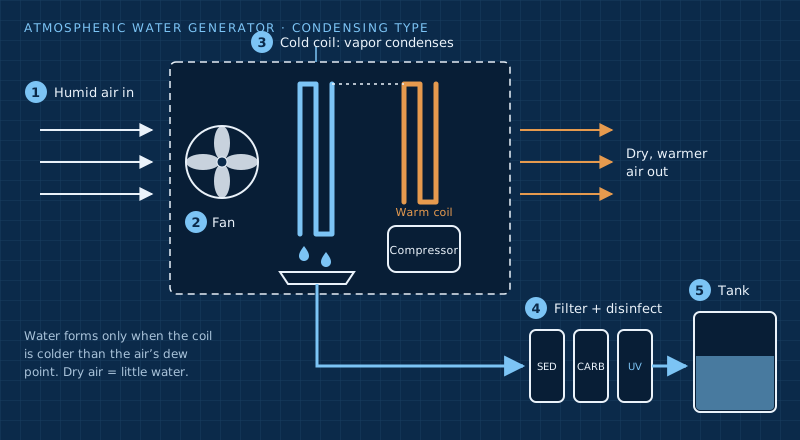
Air always carries some water vapor. Warm air can hold a lot; cold air can hold little. Chill a parcel of air and at some temperature it can no longer hold what it carries. That temperature is the dew point, and below it the surplus vapor turns to liquid on the nearest cold surface. A glass of iced tea on a summer porch is a tiny atmospheric water generator.
The parts of a condensing AWG
- Air filter and fan. Dust is removed and air is pushed through the machine.
- Evaporator coil. Cold refrigerant inside this coil chills its metal fins below the dew point. Water forms here.
- Compressor and condenser coil. The compressor pumps the refrigerant; the condenser coil releases the collected heat back to the room.
- Collection tray. Droplets run off the fins into a food-grade tray and tank.
- Treatment. Sediment and carbon filters, then UV light or ozone to kill microbes. Many units add minerals for taste.
Why humidity decides everything
Relative humidity alone can mislead, because it depends on temperature. Dew point is the better guide: it tells you directly how cold a coil must be.
| Dew point | Feels like | What a condensing AWG does |
|---|---|---|
| Above 65 °F | Muggy | Runs near or above its rated output |
| 55 to 65 °F | Comfortable to slightly humid | Half to three-quarters of rated output; less in very hot air |
| 45 to 55 °F | Dry | A trickle, at a high energy cost |
| Below 45 °F | Very dry | Little or nothing; coils frost |
You can find your current dew point in any weather app, or compute it with the National Weather Service’s dew point calculator.
The energy cost of a gallon
When water vapor condenses it releases heat: about 2,450 kilojoules per kilogram, or 0.68 kWh per liter. The machine must pump that heat away, and it also spends energy cooling the air itself, which yields no water. The drier the air, the larger that wasted share becomes.
Compressor dehumidifiers are rated by liters removed per kWh. Under standard test conditions, current models fall roughly between 1.5 and 3. In gallons, that is about 1.3 to 2.5 kWh per gallon in good air.
| Climate | Air temp / humidity | Dew point | Gallons per day | Power cost per gallon | Power needed for 60 gal/day |
|---|---|---|---|---|---|
| Hot and humid Gulf Coast summer | 88 °F / 75% | 79 °F | 8.5 | $0.24 | 3.5 kW |
| Warm and humid Southeast, late spring | 80 °F / 70% | 69 °F | 7.1 | $0.29 | 4.2 kW |
| Rated test point classic dehumidifier test condition | 80 °F / 60% | 65 °F | 6.0 | $0.34 | 5.0 kW |
| Mild air-conditioned room | 70 °F / 50% | 50 °F | 3.6 | $0.56 | 8.3 kW |
| Cool and damp coastal Northwest, basement | 55 °F / 80% | 49 °F | 4.3 | $0.47 | 7.0 kW |
| Warm and dry Mountain West afternoon | 85 °F / 30% | 50 °F | 0.5 | $4.06 | 59.7 kW |
| Hot desert Southwest summer | 100 °F / 15% | 44 °F | ≈ 0 | — | not achievable |
The last column tests a common marketing figure. Machines that really produce 60 gallons a day are industrial units drawing several kilowatts.
Other ways to pull water from air
- Thermoelectric (Peltier) coolers. Solid-state and silent, used in small desktop gadgets. They are several times less efficient than a compressor and produce cups, not gallons.
- Desiccants. Salts or silica gel absorb vapor, then heat drives it out to be condensed. This works at lower humidity than cooling coils and is how solar “hydropanels” operate. Yields are a few liters per panel per day.
- Fog nets. Mesh screens catch droplets from fog on certain mountain coasts. They use no power, and only work where fog is frequent.
- Metal-organic frameworks. Laboratory sorbents that capture water even in desert air. Promising research, not yet a home product.
DIY guides such as the Water Freedom System describe the first, cooling-coil method, because its parts are cheap and widely available.
What AWGs are good at
- Humid coastal and tropical regions, where they run efficiently most of the year.
- Replacing bottled water for drinking, at a lower cost per gallon.
- Sites with power but no safe water, such as after a contamination event.
What they are bad at
- Deserts and cold seasons. Too little vapor, too low a dew point.
- Whole-house supply. An American uses about 82 gallons a day at home; a home AWG makes a few.
- Blackouts, unless there is a generator or a large battery system behind them.
- Competing with the tap. Municipal water costs about a penny a gallon. AWG water costs 25 cents or more in electricity alone.
Common questions
Is an atmospheric water generator just a dehumidifier?
The water-making part is identical. An AWG adds food-safe materials, filtration and disinfection so the water can be drunk.
How much water can an atmospheric water generator make?
Home units make roughly 2 to 10 gallons a day in humid air. Output scales with power: about half a gallon to three-quarters of a gallon per kWh in good conditions.
Do atmospheric water generators work in Arizona or Nevada?
Cooling-coil machines work poorly there for most of the year. During the summer monsoon, when dew points rise above 55 °F, they produce modest amounts, mostly in the cooler night hours.
Can an AWG run on solar power?
Yes, with enough panels. A 500-watt unit running around the clock needs about 12 kWh a day, which takes roughly 3 kW of panels and a battery bank.
Is the water safe?
Only after treatment. See is water from air safe to drink?
Sources
- ENERGY STAR, Dehumidifiers (rating method, liters per kWh).
- National Weather Service, dew point calculator.
- Wikipedia, Atmospheric water generator (overview of cooling and desiccant methods).
- U.S. EPA WaterSense, Statistics and Facts.
- Latent heat of condensation of water at room temperature: about 2,450 kJ/kg (standard physical constant).